
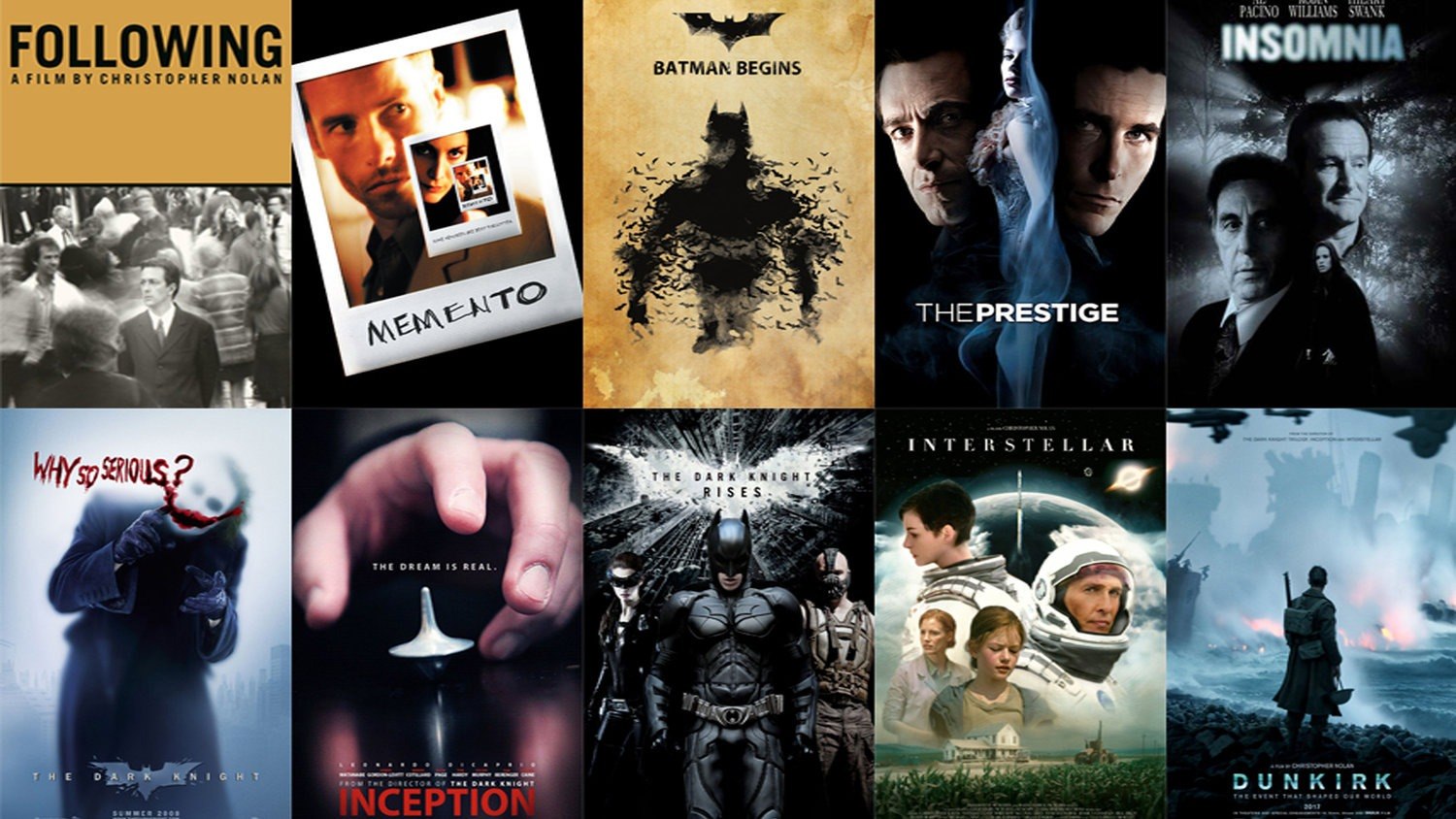
Across 13 films, including The Dark Knight, Memento, Inception, Oppenheimer and The Odyssey, Christopher Nolan has transformed complex ideas into unforgettable cinematic experiences.
Long before Christopher Nolan began constructing cities inside dreams, sending astronauts through wormholes or recreating history on an IMAX canvas, he was an eight-year-old fascinated by a Super 8 camera. What began as childhood curiosity soon became an enduring obsession, not merely with watching films, but with understanding how images, editing, sound and time could shape an audience’s emotions. That fascination has remained in the centre to his filmmaking for more than four decades.
Nolan’s career is a study in what it takes to enter the league of filmmaking legends. Imagination alone is never enough. It requires discipline, technical command, unwavering conviction and the courage to pursue ideas that may initially appear too complicated, expensive or unconventional. Nolan possesses that rare combination of an artist’s curiosity and an engineer’s precision. He can consider the emotional meaning of time while simultaneously working out how to capture an impossible sequence practically.
His journey has also helped erase the perceived boundary between independent filmmaking and mainstream entertainment. Nolan did not turn independent cinema into a genre. Instead, he carried its most valuable qualities, including resourcefulness, experimentation and a fiercely personal point of view, into the centre of the studio system. His earliest feature was assembled with friends, available locations and an extremely limited budget. Today, he commands some of the largest productions in cinema without surrendering that original authorial spirit.
With The Odyssey becoming Nolan’s 13th feature, it is time to revisit his complete filmography. Even the films near the bottom reveal extraordinary craftsmanship. The difference between them often comes down to emotional depth, narrative clarity and how successfully Nolan balances intellectual ambition with human connection.
Here is every Christopher Nolan movie ranked from his least essential to his greatest achievement.
13. Insomnia (2002)
A detective arrives in an Alaskan town where the sun refuses to set, only to discover that sleeplessness can distort the mind as effectively as darkness. Al Pacino brings exhaustion and moral unease to the role of Will Dormer, an experienced investigator pursuing a calculating murder suspect played with unnerving restraint by Robin Williams. Hilary Swank provides the film’s moral centre as a local officer gradually questioning the man she once admired.
Nolan uses the endless daylight beautifully, turning brightness into something oppressive rather than comforting. The landscape feels exposed, yet the characters remain surrounded by secrets.
Insomnia is an assured psychological thriller, but it is also Nolan’s least personal work. As the only feature he directed without receiving a writing credit, it lacks the architectural storytelling and conceptual audacity that would become inseparable from his identity. It remains an effective film, but it is not the clearest expression of its director.
12. Tenet (2020)
Few filmmakers would attempt to build a global espionage thriller around objects and people moving through time in opposite directions. Fewer still would stage that premise using enormous practical sequences rather than allowing digital effects to carry the experience.
John David Washington leads the film as an operative drawn into a conflict that stretches beyond conventional ideas of cause and consequence. Robert Pattinson brings welcome charm and mystery, while Elizabeth Debicki gives the story its strongest emotional dimension.
Visually, Tenet is frequently astonishing. Its inverted chases, mirrored confrontations and massive set pieces demonstrate Nolan’s technical confidence at full force. The difficulty is that the machinery of the plot often receives more attention than the people trapped within it. Explanations arrive quickly, dialogue competes with an overwhelming soundscape and emotional involvement can become secondary to decoding the rules.
It is bold, original and impossible to dismiss. Yet it sometimes feels more like a magnificent cinematic equation than a fully inhabited world.
11. Following (1998)
Before the enormous cameras, international locations and celebrated ensembles, there was a black-and-white film made with friends over a series of weekends.
Following centres on a directionless young man who begins trailing strangers through London, convincing himself that observing their lives will provide material for his writing. When one of his subjects notices him, curiosity becomes complicity, drawing the young man into theft, manipulation and shifting identities.
The film already contains the foundations of Nolan’s future work: fractured chronology, obsessive characters, unreliable perspectives and information deliberately withheld from the audience. Its limitations become part of its personality. Sparse rooms, available streets and natural lighting create a restless, secretive London.
Produced for approximately £3,500 and filmed across months of Saturdays, Following demonstrates Nolan’s independent roots in their purest form. Its ingenuity would lead directly towards the breakthrough of Memento. It may be rough around the edges, but it proves that scale begins with an idea, not a budget.
10. The Dark Knight Rises (2012)
Concluding a trilogy as influential as Nolan’s Batman saga was always going to be an immense challenge. Instead of attempting to repeat the previous film, The Dark Knight Rises expands outward, transforming Gotham’s crisis into a battle over fear, power and social order.
Christian Bale plays an older, physically diminished Bruce Wayne who has withdrawn from the city he once protected. Tom Hardy’s Bane is an imposing adversary whose intelligence matters as much as his strength, while Anne Hathaway gives Selina Kyle a sharp combination of wit, uncertainty and self-interest.
The opening aerial operation remains one of Nolan’s most commanding action sequences, while Bruce’s imprisonment provides the film with its most resonant emotional idea. Escaping despair requires more than physical strength.
However, the story becomes crowded as it moves towards its conclusion. Several developments depend on convenient timing, and Gotham’s prolonged isolation raises questions the screenplay cannot entirely answer. Even so, the film closes the trilogy with genuine scale and emotional finality, allowing Bruce Wayne’s journey to arrive at a meaningful destination.
9. Memento (2000)
Memento announced the arrival of a filmmaker who understood that structure could become part of a story’s psychology.
Guy Pearce plays Leonard Shelby, a man unable to form new memories after a traumatic event. Determined to find the person responsible for his wife’s death, Leonard depends on photographs, handwritten notes and tattoos to preserve information that his mind cannot hold.
Instead of simply explaining Leonard’s condition, Nolan makes the audience experience it. One narrative moves backwards, removing the context behind each new scene, while another moves forward towards the point where both timelines meet. Every apparent discovery carries uncertainty because neither Leonard nor the viewer can be certain which facts have been misunderstood, manipulated or deliberately manufactured.
Developed from a concept by Jonathan Nolan, the film turns a noir mystery into a meditation on identity. If memory gives life continuity, what happens when that continuity disappears? More importantly, what if people choose the beliefs that make their lives bearable?
More than two decades later, its construction remains daring, while its central dilemma remains deeply unsettling.
8. Dunkirk (2017)
In Dunkirk, time is not simply a storytelling device. It becomes the source of tension.
Nolan presents the wartime evacuation through three perspectives operating across different durations: soldiers waiting on the beach, civilians travelling across the sea and pilots fighting above them. These timelines gradually converge, turning separate acts of endurance into one collective experience.
Dialogue is limited, traditional backstories are stripped away and the relentless rhythm of Hans Zimmer’s score keeps the film in a state of almost continuous motion. The result is less a conventional historical drama than a sensory reconstruction of survival, defined by engines, water, open skies and the uncertainty of rescue.
That same restraint also creates distance. Many of the young soldiers are deliberately presented as faces within a larger event rather than individually developed characters. Viewers may admire their struggle without forming the intimate attachment found in Nolan’s most emotionally powerful work.
Still, Dunkirk demonstrates extraordinary control. It communicates scale without losing clarity and heroism without relying on grand speeches.
7. Batman Begins (2005)
Batman Begins did more than revive a superhero. It reconsidered what a superhero film could become.
Nolan approaches Bruce Wayne’s transformation as a psychological and moral journey. Fear is not merely something Batman causes in criminals. It is something Bruce must first understand within himself. Gotham, meanwhile, is portrayed as a city shaped by organised crime, political compromise and institutional decay.
Christian Bale captures both sides of the character: the wounded man searching for purpose and the public billionaire performing carelessness to conceal it. Michael Caine brings warmth and honesty to Alfred, while Gary Oldman’s restrained Jim Gordon offers Bruce a rare example of integrity.
The film’s tactile environments and practical approach give its comic-book world unusual credibility. Its final section becomes more conventional than its thoughtful opening, but that does not diminish its influence. By treating Batman as the centre of a serious crime drama, Nolan created a model that blockbuster filmmaking would follow for years.
6. Inception (2010)
Inception represents Nolan’s extraordinary ability to persuade a mass audience to enter a world governed by complicated rules and then make those rules thrilling.
Leonardo DiCaprio plays Cobb, a specialist who enters dreams to extract valuable information. His most dangerous assignment asks him to do the reverse: place an idea inside another person’s mind without revealing where it came from.
The premise allows Nolan to construct several realities operating simultaneously, each with its own rhythm and perception of time. A moment in one layer can stretch into an entire sequence in another. Yet beneath the architecture lies a story about guilt, grief and a man who can manipulate other people’s minds but cannot control his own memories.
Its folding cities, shifting gravity and layered climax have become part of modern cinematic vocabulary. Hans Zimmer’s score gives the film both momentum and melancholy, while its final image leaves the audience with a question that matters less than Cobb’s decision to stop asking it.
This is puzzle-box filmmaking with the force of a blockbuster. It is also one of Nolan’s clearest demonstrations that complexity can be commercially exhilarating.
5. Interstellar (2014)
Nolan is frequently characterised as an emotionally distant filmmaker, but Interstellar offers the strongest argument against that perception.
Matthew McConaughey plays Cooper, a former pilot who leaves his children behind to join a mission searching for a future home for humanity. The journey carries him across unfamiliar worlds, but the film’s emotional centre remains the bond between Cooper and his daughter Murph.
Time becomes both a scientific phenomenon and a personal tragedy. Minutes for one character can become years for another, turning relativity into the distance between a parent and child. McConaughey’s performance gives that idea tremendous emotional weight, particularly when Cooper is forced to confront everything he has missed.
The film occasionally explains its themes too directly, and its final movement asks the audience to accept an unusuallysentimental interpretation of human connection. Nevertheless, its ambition is difficult to resist. Interstellar combines cosmic scale with intimate longing, creating a space epic that is ultimately less concerned with discovering distant planets than with finding a way home.
4. The Prestige (2006)
Every magic trick depends on what the audience fails to notice. The Prestige builds an entire film around that principle.
Christian Bale and Hugh Jackman play rival illusionists whose professional competition gradually consumes their identities, relationships and moral boundaries. Each man becomes so determined to surpass the other that the original purpose of their art, which is to create wonder, is buried beneath obsession.
The screenplay, written by Christopher and Jonathan Nolan and adapted from Christopher Priest’s novel, operates like an elaborate illusion. Information is placed directly before the viewer, but context disguises its importance. Diaries conceal agendas, narrators prove unreliable and scenes acquire different meanings when revisited.
Bale and Jackman make the rivalry intensely personal, while Michael Caine provides the perspective of a craftsman who recognises the danger before either magician does. David Bowie’s appearance as Nikola Tesla adds another dimension to a story already poised between science and spectacle.
More than a mystery, The Prestige may be Nolan’s sharpest examination of artistic obsession and the sacrifices demanded by the pursuit of greatness.
3. Oppenheimer (2023)
With Oppenheimer, Nolan transformed a dense historical biography into an urgent cinematic event.
Cillian Murphy delivers a controlled, deeply internal performance as J. Robert Oppenheimer, the theoretical physicist placed at the centre of the effort to develop the atomic bomb. Rather than presenting history as a straightforward sequence, Nolan divides it through competing viewpoints, political hearings, memories and consequences that stretch far beyond the project itself.
The Trinity test is staged with extraordinary tension, but the film’s most haunting passages explore what follows achievement: celebration giving way to dread, scientific triumph becoming moral uncertainty and one man recognising that his work can no longer be contained by his intentions.
The final section is deliberately dense, shifting from world-changing science to political procedure and personal retaliation. Its length and volume of dialogue can be demanding. Yet that contrast is essential to Nolan’s argument. History is shaped not only by enormous discoveries, but also by smaller rooms in which reputations and narratives are controlled.
The film won seven Academy Awards, including Best Picture and Nolan’s first Oscar for directing. Its victories formally recognised what his filmography had demonstrated for years.
2. The Odyssey (2026)
After looking towards dreams, space and modern history, Nolan turns to one of storytelling’s oldest surviving foundations.
Matt Damon plays Odysseus, the king of Ithaca attempting to return home after the Trojan War. His voyage is shaped by hostile seas, mythical forces, temptation and the growing uncertainty of whether the life he remembers still waits for him. Back in Ithaca, Penelope, played by Anne Hathaway, must defend their household while their son Telemachus, played by Tom Holland, confronts a world eager to declare Odysseus lost.
Nolan treats mythology as something physical rather than distant. Ships occupy real seas, landscapes tower over the characters and fantastical encounters possess texture and weight. The filmmaker’s preference for practical environments gives the adventure a sense of danger that polished digital imagery rarely achieves.
This is also Nolan’s first feature photographed entirely with IMAX cameras, extending his lifelong mission to make the cinema screen feel less like a frame and more like an environment. The film opened in cinemas on 17 July 2026.
For all its spectacle, the story remains anchored by a simple human desire: to survive long enough to return to the people who still remember you. The Odyssey feels both ancient and immediate. It is a monumental production guided by the instincts of the young filmmaker who once built entire worlds from whatever he had available.
1. The Dark Knight (2008)
The Dark Knight remains Nolan’s finest film because every element, including performance, theme, action and structure, works towards the same escalating moral conflict.
Heath Ledger’s Joker is not simply a villain confronting Batman. He is an idea given human form, an agent of disorder determined to prove that Gotham’s principles will collapse under sufficient pressure. Ledger’s unpredictable performance dominates the film without overwhelming its larger story.
Christian Bale’s Bruce Wayne faces a different kind of defeat. He can stop individual crimes, but he cannot easily protect a city’s belief in justice. Aaron Eckhart’s Harvey Dent becomes the emotional bridge between Batman’s idealism and the Joker’s nihilism, giving the conflict tragic consequences.
Nolan stages the film as an expansive urban crime thriller rather than a traditional superhero adventure. Its action is immediate, its moral questions are accessible without being simplistic and its momentum rarely weakens across its substantial running time.
Most importantly, the spectacle never replaces the drama. Every major sequence forces a character to make a choice, and every choice changes the meaning of what follows. That balance between entertainment and intelligence, scale and intimacy, is the defining achievement of Nolan’s career.
The Obsession Behind the Legacy
Christopher Nolan’s films are not easy to understand. His dialogue can become heavily explanatory, his characters can appear secondary to his ideas and his fascination with structure occasionally asks too much of the audience. But legendary filmmakers are rarely remembered for removing every eccentricity from their work. They are remembered for possessing a vision strong enough to change what audiences expect from cinema.
Nolan’s greatest quality is conviction. He trusts viewers to follow difficult narratives. He trusts physical environments to create sensations that cannot be manufactured entirely inside a computer. He trusts that a film about theoretical physics, fractured memory or an ancient Greek voyage can become a global event when approached with clarity and commitment.
He began as an independent filmmaker solving problems with limited money, borrowed spaces and a small group of collaborators. The productions have grown, but the underlying mentality remains: protect the central idea, use every available resource intelligently and never treat the audience’s attention casually.
That is how Nolan brought the spirit of independent filmmaking into the mainstream. He did so not by reducing his ambitions to suit the system, but by expanding the system until it could accommodate them.
Updated 2 Oct 2026, 04:22 GMT+0000


Comments आपकी राय