
Sita’s sword is not a twist—it’s a forgotten Ramayana tradition
Nitesh Tiwari's Ramayana: Rise of a Legend lets Sita fight with a sword. The choice is less an invention than a return to a lesser-known epic tradition.
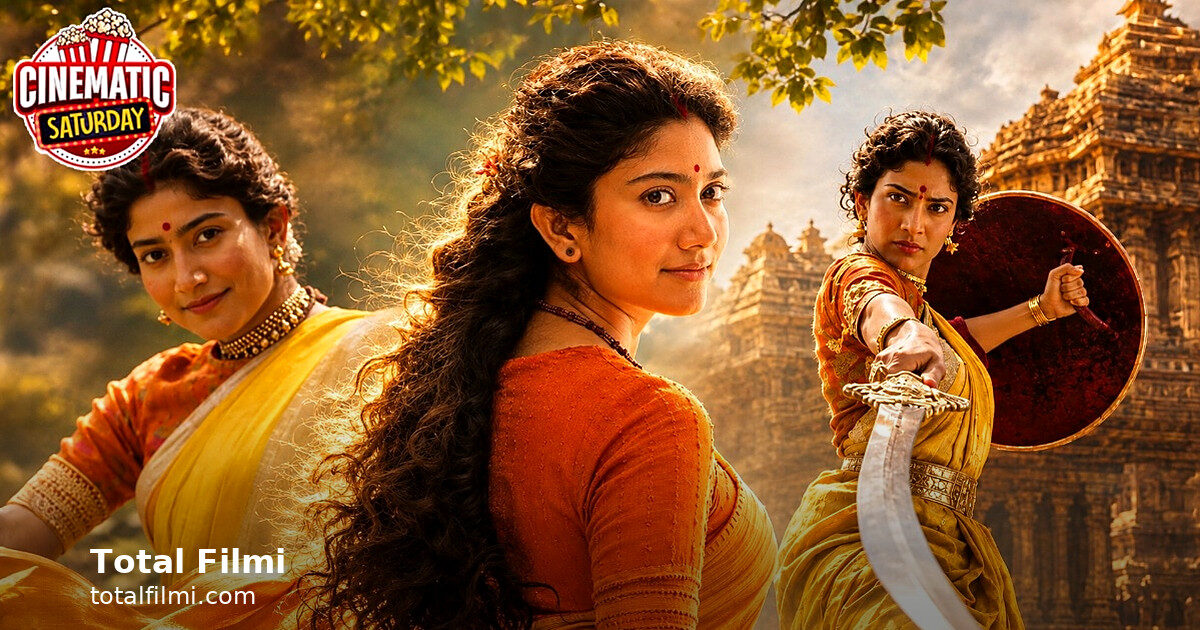
Nitesh Tiwari’s Ramayana: Rise of a Legend has not just reopened an old debate; it has handed Sita a sword. For audiences raised on television Ramayanas and Ramlilas, the image of Sai Pallavi’s Sita fighting demons beside Rama and Lakshman during exile can feel like a departure. But the film’s real provocation is quieter: it asks whether our popular memory of Sita has celebrated her endurance so much that it forgot her capacity to fight.
Speaking at the film’s Los Angeles premiere, Tiwari pointed to the Adbhut Ramayana, one of the many retellings of the epic, as his textual anchor. He described its Sita as a “warrior princess” and said that dimension was brought into the film. That matters because Tiwari is not claiming the familiar Valmiki version shows Sita fighting Khara and Dushana in the forest. He is borrowing from a wider tradition and then expanding it into his own cinematic world.
The Sita who saves Rama
The Adbhut Ramayana offers one of the most striking reversals in the Ramayana universe. After Rama defeats the ten-headed Ravana, the text introduces a far more dangerous enemy: Sahasramukha Ravana, the thousand-headed demon king. When Rama falls in battle, Sita steps forward, takes on a fierce form associated with Mahakali, and destroys the demon and his army. Rama then offers her a thousand names.
In that telling, Sita is not simply the woman Rama must rescue. She is the force capable of rescuing him. A verse translated in the source describes her as the supreme Shakti, not a consort or an extension of another divine being. Devotion and power are allowed to coexist.
A sword, a test and a woman who knows her mind
Tiwari’s film gives that warrior dimension a physical vocabulary. Sita carries a sword, trains young girls in Ayodhya, and joins Rama and Lakshman when demons attack. In the Khar-Dushan episode, she is not waiting in a cave; she is in the middle of the action. The film does nod to Valmiki’s Aranya Kanda, where Rama asks Lakshman to take Sita to safety, but then it adds a second demon army that forces her into combat.
The changes go beyond action. When Ravana arrives disguised as a sadhu, Sita does not simply accept his story. She asks him to recite a verse to prove he is the learned man he claims to be. The test may not prevent the abduction, but it turns her from an oblivious victim into someone alert to the danger.
After the abduction, Sai Pallavi’s Sita refuses to give Ravana the satisfaction of seeing her broken. She tells him that taking her will be the start of his undoing. Her grief surfaces not for herself but for Jatayu, who died trying to protect her. That is not emotional coldness; it is deliberate defiance.
Why the outrage misses the epic’s own plurality
The argument against a sword-wielding Sita often assumes the Ramayana is a single, fixed story. But scholars such as A. K. Ramanujan have pointed to hundreds of retellings across languages, regions and religious traditions. The number often cited is around 300, though it is an estimate rather than a census. The point is not the count; it is that the epic has survived by being retold, shaded and reconsidered.
That does not mean every cinematic invention should be treated as scripture. It does mean audiences can debate the film’s choices without claiming their version is the only legitimate one.
- The Adbhut Ramayana gives Sita a warrior form and lets her defeat a thousand-headed Ravana.
- Modern retellings such as Amish Tripathi’s Sita: Warrior of Mithila also imagine her as a trained fighter.
- Tiwari blends that tradition with Valmiki’s forest narrative rather than erasing it.
The real question is what feels threatened by the sight of Sita fighting. Does self-defence diminish Rama’s heroism? Does physical strength make her less devoted? A woman can love her husband and still have an identity beyond marriage. She can be devoted without being dependent, and compassionate without being vulnerable to manipulation.
Tiwari’s film is not asking Sita to stop being a goddess. It is asking whether goddesshood has to mean powerlessness. The epics have always held more than one Sita; we are just being reminded to read beyond the version we inherited.
Source: India Today


Comments आपकी राय